
Things to know before going to Amed, Bali
Amed is one of those places where you quickly realise that time works differently. There is very little traffic, life moves slowly and nobody seems to be in a hurry. And yet, somehow, you will probably spend a surprising amount of time going backwards and forwards along the coast trying to find what you need.
This is not because Amed is chaotic. It is because almost nothing is in the same place.
Need petrol? You may have to drive to another village.
Need a particular ingredient? Maybe another shop.
Need something that is not available locally? You may end up ordering it from the south of Bali.
Looking for a specific service? Good luck finding it five minutes from where you are staying.
And honestly, that is part of life here.
After spending time in Amed, these are the things I wish everyone knew before arriving.
1. Amed is much more spread out than it looks
When you look at Amed on a map, it is easy to imagine a small seaside village where everything is within walking distance.
It isn’t.
Amed is a collection of coastal villages and areas stretching along East Bali. Where you stay can make a huge difference to your everyday life.
A restaurant that looks “nearby” on Google Maps may actually mean a scooter ride along the coast. A shop you need may be several kilometres away. And if you live further up in Bunutan or Lipah, the roads can become steep and more complicated.
Before choosing where to stay Where to stay in AmedUnderstand the different villages and areas of Amed before booking your accommodation.
2. There is no Grab or Gojek
This is one of the first practical differences you will notice.
Grab and Gojek are not available in Amed in the same way they are in South Bali.
You cannot simply open an app and expect a scooter or car to arrive at your door within minutes.
For everyday life, having your own scooter or car makes things considerably easier.
If you do not want to drive, you can use local drivers. They are generally more expensive than app-based rides elsewhere on the island because there is no comparable level of competition.
If you are staying in Amed for more than a few days, organise your transport early. A local driver is useful for longer journeys, airport transfers and day trips, while a scooter is usually the easiest option for everyday movement if you are an experienced rider.
Find out how to reach Amed from the airport and other parts of Bali, and what transport options make the most sense.
3. Petrol stations are not always as reliable as you expect
This is one of those things you understand only after living here for a while.
There are official petrol stations around the Amed area, but fuel availability cannot always be taken for granted.
Sometimes a station can simply run out of petrol.
And this is where Amed becomes slightly absurd.
You can be driving around an area with almost no traffic, surrounded by beautiful rice fields and the sea, and suddenly realise that you have to drive all the way to Bebayu because the petrol station closer to you has run out of fuel.
There are also periods when official stations can close temporarily because of supply problems.
If you are travelling around Amed by scooter, keep enough fuel in the tank for the return journey. Local petrol sold in bottles at small shops and warungs can be useful when official stations are unavailable, but prices are usually higher.
Official petrol stations around Amed
These are the locations we use as useful reference points when moving around the area:
Fuel availability can change, so do not treat this list as a guarantee that every station will always have petrol.
4. Grocery shopping takes a little planning
One of the biggest adjustments if you are staying in Amed for a longer period is grocery shopping.
There are shops and minimarkets, but the selection is naturally much smaller than in Ubud, Canggu or the south of Bali.
If you need something specific, you may have to visit more than one shop.
And if you are looking for imported products, Western ingredients, children’s products or anything particularly specific, you may need to order from suppliers in the south.
Our favourite places for groceries
For everyday shopping, these are some of the places we find most useful:
The trick is not to wait until you desperately need something.
If you see something you regularly use, buy it when you find it.
5. You will probably spend more time on your scooter than expected
Amed is wonderfully quiet compared with South Bali. You can drive along the coast without spending your life sitting in traffic.
But you may still find yourself driving constantly.
The reason is simple: everything is spread out.
One day you might drive south for groceries, north for snorkeling, back towards Bunutan for lunch and then towards Bebayu for something else.
It sounds ridiculous until you live here.
And because the roads are usually enjoyable to ride along, especially beside the coast, it does not necessarily feel like a burden.
6. Amed has fewer services than South Bali
This is probably the biggest practical difference to understand before moving here or staying for several weeks.
Amed is growing quickly, and new businesses appear all the time. But it still does not have the enormous choice of services available in Canggu, Seminyak, Sanur or Ubud.
This applies to everything from shopping and transport to laundry, children’s products, technology, fitness and specialised services.
Some things are easy to find. Others are surprisingly difficult.
And sometimes the thing you are looking for exists, but only in a very specific part of Amed.
7. Do not expect Bali’s usual delivery culture
One of the luxuries of living in South Bali is how easy it is to order almost anything.
Amed is different.
Food delivery is much more limited, and services that you might normally access through an app are not necessarily available.
This is another reason why having your own transport changes everything.
8. Amed is quiet, but it is not boring
If you are expecting nightlife, beach clubs and parties, Amed is probably not the right place.
Evenings are generally quiet.
But that does not mean there is nothing to do.
You can watch the sunset, eat at a local warung, sit by the sea, go snorkeling, dive, have a coffee, walk through the villages or simply enjoy the fact that nobody is asking you to hurry.
This is one of the reasons people who come to Amed for a few days sometimes end up staying much longer than planned.
9. The beaches are not all sandy
This is worth knowing if you are arriving with children or imagining a classic tropical beach.
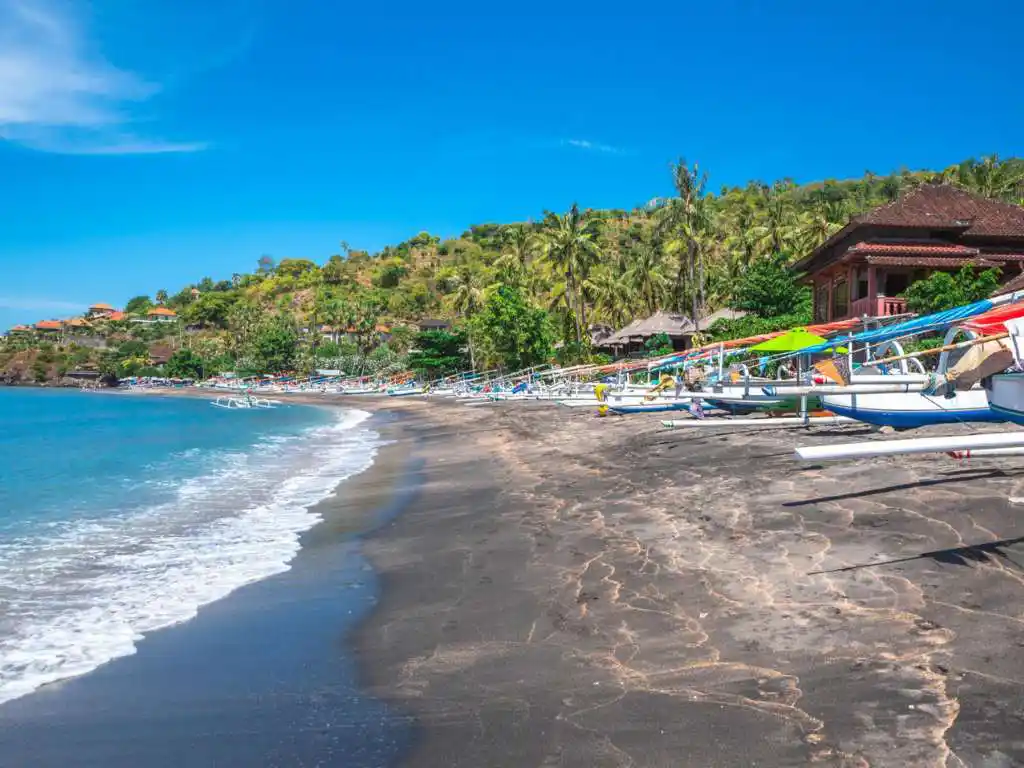
Many beaches around Amed have volcanic stones, pebbles and darker sand rather than long stretches of soft golden sand.
Lipah is one of the better choices if you want a beach that works well both for snorkeling and for children who simply want to play on the sand.
Other beaches are beautiful precisely because they are more rugged and natural.
Bring suitable footwear if your feet are sensitive, and do not judge Amed’s coastline by whether it looks like a postcard beach.
10. The sea is one of the reasons to come here
If you like snorkeling or diving, Amed makes much more sense.
The underwater world is one of the area’s biggest attractions, and several sites can be accessed relatively easily from the coast.
This is also why Amed can work particularly well for families with children who enjoy the sea.
Explore the underwater side of Amed Snorkeling in AmedFind the best snorkeling spots and practical information before getting into the water.
11. Some areas are much hillier than others
When choosing accommodation, pay attention to the exact location.
Areas around Bunutan and Lipah can become quite steep as you move inland and uphill. Some roads are perfectly manageable on a scooter but less comfortable in a small car, particularly after rain.
If you are travelling with young children, elderly relatives or lots of luggage, this is something worth considering before booking.
“Amed” on a booking website does not necessarily tell you what the road to the property will actually be like.
12. Internet can be frustrating
If you are coming to Amed to work remotely, do not assume that your internet connection will be as reliable as it is in the south of Bali.
Connection quality can vary significantly depending on where you stay, and mobile data can also be inconsistent.
Power cuts can happen too.
If your income depends on being online, choose accommodation carefully and ask about the actual connection rather than simply accepting “Wi-Fi available” as an answer.
It is also sensible to have a backup mobile connection if your work is time-sensitive.
13. You may have to compromise on convenience
This is probably the biggest overall lesson.
Amed is cheaper and slower than much of South Bali, but you give something up in exchange.
You may have a beautiful house close to the sea but no washing machine.
You may find an amazing restaurant but no delivery.
You may find cheap local food but have to travel for specific Western ingredients.
You may find a great house at a good monthly price but need a scooter for absolutely everything.
This is not a flaw in Amed.
It is the trade-off you make for living somewhere quieter and less developed.
If something takes a little longer, costs a little more or requires a 20-minute scooter ride, you learn not to get annoyed about it. You simply add it to the rhythm of life here.
14. Learn to buy what you need when you see it
This sounds like a small thing, but it can make everyday life much easier.
If you know you will need sunscreen tomorrow and you see your preferred brand today, buy it.
If you find the coffee you like, buy another packet.
If the supermarket has the ingredients you need for the week, take them.
Amed is not the place where you can always assume the same product will be sitting on the shelf tomorrow.
15. Local warungs are part of everyday life
One of the best things about Amed is that you do not need to eat in expensive restaurants to eat well.
Local warungs remain an important part of everyday life, and simple Indonesian food can be incredibly good and inexpensive.
If you are open to nasi goreng, mie goreng, nasi campur, fresh fruit and other local dishes, eating in Amed can be surprisingly affordable.
And even when you want Western food, there are increasingly more independent restaurants and cafés opening around the area.
16. Amed is changing quickly
Amed is not frozen in time.
More accommodation is being built, new restaurants and cafés are opening, and more people are discovering the area.
This is bringing more choice, but it is also changing prices and the character of some parts of the coast.
If you visited Amed several years ago, you may already notice a difference.
The important thing is that, for now, it is still possible to find the slower, quieter side of Amed that makes the area special.
17. You will probably drive past the same places several times
This deserves its own point because it is one of the most accurate descriptions of Amed life.
You can spend the morning driving around looking for something, finally find it, go home, realise you forgot something else and turn around again.
There is no traffic.
There are no huge shopping centres.
There are no endless queues.
And somehow you still spend half the day on your scooter.
18. Do not try to see everything in one day
This is especially important if you are visiting Amed as part of a larger Bali itinerary.
Amed is not a place I would rush through.
Give yourself time to snorkel, eat slowly, explore the villages and simply spend some time without a schedule.
If you want to explore East Bali, choose one good day trip rather than trying to fit every attraction into a single day.
Tirta Gangga and Maha Gangga, for example, work beautifully together because they offer two completely different experiences without requiring a huge amount of extra driving.
One of our favourite East Bali day trips Tirta Gangga from AmedA complete guide to the royal water garden, including how to get there, tickets, history and how to combine it with Maha Gangga.
19. Choose your accommodation based on your lifestyle
Do not simply choose the prettiest villa.
Think about what you will actually do every day.
Do you want to walk to restaurants?
Do you want to snorkel from the beach?
Do you need reliable internet?
Do you have children?
Do you need a washing machine?
Will you have a scooter?
Do you mind being uphill?
These questions are much more important than simply looking at photographs of the property.
Choose the right area Where to stay in AmedA practical guide to Amed’s villages and areas, including what each part of the coast is like.
20. The best thing about Amed is also the thing that makes it inconvenient
Amed is less developed.
That means fewer services, fewer transport options, fewer shops and less convenience.
But it also means less traffic, fewer crowds, more space, a slower rhythm and a much stronger connection with everyday life.
You cannot really separate the two.
You cannot have Amed’s quietness without accepting some of its inconveniences.
And once you stop comparing it with South Bali, those inconveniences often become much easier to accept.
Amed before you go: the short version
- Amed is spread out, so choose your location carefully.
- There is no Grab or Gojek, so plan your transport.
- A scooter is extremely useful for everyday life if you are an experienced rider.
- Local drivers are available but can cost more than app-based transport elsewhere.
- Keep your petrol tank reasonably full because fuel availability can change.
- Do not expect to find everything you need in one shop.
- Solaluna, Adi Shop and AW are useful places for everyday groceries.
- Internet quality can vary, so check before booking if you work online.
- Many beaches are rocky or pebbly; Lipah is one of the better choices for families.
- Snorkeling and diving are among the main reasons to come to Amed.
- Some inland areas are steep, particularly around parts of Bunutan and Lipah.
- Do not overplan your days. Amed is best experienced slowly.
- Expect some inconvenience and consider it part of the experience.
So, is Amed difficult?
Sometimes.
But not in the way you might think.
It is not difficult because of traffic, crowds or complicated logistics. It is difficult because Amed asks you to stop expecting everything to be immediately available.
You have to drive a little further. Look a little harder. Plan a little better. Accept that the petrol station might not have petrol and that the shop might not have what you were looking for.
And then, suddenly, you are sitting by the sea with a coffee, watching the fishing boats and wondering why you were in such a hurry in the first place.
That is what you should know before going to Amed
Amed is not the most convenient place in Bali.
It is not designed to give you everything in one place.
But if you are willing to adapt to its rhythm, the reward is a quieter, slower and much more authentic way of experiencing East Bali.