
Slow Living in Amed
Why Amed feels like a completely different Bali
While most of Bali keeps accelerating “more traffic, more crowds, more noise” Amed has stayed behind on purpose. This is what slow living actually looks like on Bali’s quiet east coast.
Most people arrive in Bali expecting traffic.
They expect the crowd. The noise. The twenty-minute gridlock just to cross a single junction in Canggu. The scooters parked in every direction. The beach clubs with the same music playing everywhere.
They expect the version of Bali that Instagram built.
And then they drive north, past Singaraja, down into East Bali, and suddenly ” almost without realising it â” everything changes.
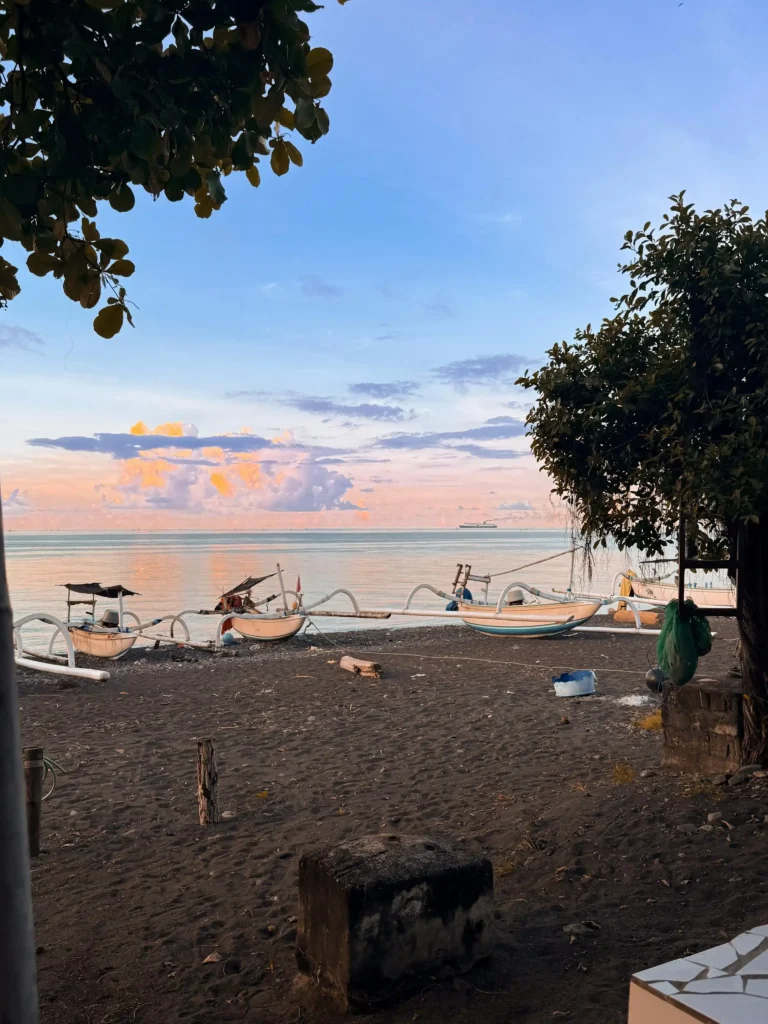
The road gets narrower. The villages get quieter. The ocean appears on the left, black volcanic sand instead of white, fishermen instead of surfers.
And then they reach Amed.
And they wonder why no one told them about this place before.
A DIFFERENT BALI
Amed is not a quieter version of Bali. It’s a different version entirely.
There’s no traffic inside Amed. Not because it’s managed well ” but because there simply isn’t enough of it to create the problem”.
There are no beach clubs competing for your attention. No rooftop bars. No infinity pools designed for photoshoots. No digital nomad cafès with queues at the door.
What there is, instead, is the sea. The mountains. The road running along the coast with almost nothing between you and the water. Small warungs. Fishermen hauling their jukung boats out before sunrise. Local life moving at its own pace, with or without tourists watching.
Southern Bali has spent twenty years building infrastructure for mass tourism. Amed never did. And that ” more than anything else ” is why it still feels like somewhere real.
See how Amed compares to other places in Bali
DAILY LIFE
What slow living in Amed actually looks like
It starts with the morning.
You wake up usually early, because the village is already moving and within five minutes you can be in the water. No commute. No plan required. Just the ocean, the sunrise over the volcanoes, and nothing urgent anywhere.
That’s what slow living in Amed actually means. Not a lifestyle philosophy. Not a retreat program. Just a place where the default pace of things is slower and where that slowness is structural, not forced.
Days here tend to organise themselves around a few fixed points: the sea, meals, the light. You snorkel before breakfast. You eat when you’re hungry, usually at a warung with no menu pressure and no time limit. You watch the fishermen come back in the afternoon. You’re in bed earlier than you expected.
It sounds simple because it is simple.
And for many people, especially those arriving from southern Bali, or from months of constant movement that simplicity feels like the most radical thing they’ve experienced in years.
WHY PEOPLE LEAVE THE SOUTH
What people are actually escaping when they come to Amed
Ask almost anyone who moved to Amed after living somewhere else in Bali, and the answer is usually the same.
It wasn’t one big thing. It was an accumulation of small things that stopped feeling worth it.
The forty-five minutes to go nowhere. The noise that never fully stops. The sense that you’re living in a place built entirely around tourism, where even the “local experience” has been packaged and priced. The cafès full of people who all arrived recently and will leave next week. The constant movement that somehow doesn’t feel like going anywhere.
At some point, the trade-off stops making sense.
You have access to everything in southern Bali and yet something feels missing. Usually it’s quiet. Often it’s space. Sometimes it’s just the ability to hear yourself think.
Amed solves all of these things immediately. Not by offering alternatives but by removing the problem entirely.
There’s no traffic to escape because there’s no traffic. There’s no noise to manage because the loudest thing is usually the ocean. There’s no social pressure around what you’re doing or where you’re going, because most people here are doing very little and that’s considered completely normal.
BEING HONEST
Slow living has a real cost. Here it is.
None of this is free.
Amed is genuinely remote. The road connecting it to the rest of Bali is the same road everyone else uses scooters, trucks, supply vehicles, tourists and some days the drive becomes unpredictable in a way that feels almost personal.
There’s no supermarket. No fast delivery. No imported products appearing at your door the next morning. When you need something specific something medical, something technical, something you forgot to bring getting it requires planning, patience, and often a full day on the road.
Power cuts are part of life here. So is unreliable internet on certain days. So is the absence of variety one Indian restaurant, one bakery, one of most things and the understanding that if that one option isn’t available today, there probably isn’t another one nearby.
You also lose the rhythm of a busy social life. The spontaneous nights out. The energy of being surrounded by people who are always doing something.
In Amed, most evenings end early. Most days look similar to the day before.
Whether that sounds like a problem or a relief says a lot about whether Amed is right for you.
IS THIS FOR YOU?
Slow living in Amed works… for certain people
It tends to work well for people who already know what they’re looking for.
Divers who want the ocean five minutes away, not forty-five. Remote workers who need functional internet but not a coworking scene. Couples and families who want space, nature, and a real sense of community without the chaos. Slow travelers who’ve already done the other version of Bali and are ready for something that feels less performative.
It’s also surprisingly good for people who aren’t sure what they want but know that what they currently have isn’t it. Amed has a way of slowing things down enough that clarity tends to arrive on its own.
It doesn’t work well for people who need stimulation to feel alive. Or who measure a good trip by how many options they have. Or who need the social proof of being somewhere popular.
Amed is not popular in that way. It’s just genuinely good. And that distinction matters.
Is slow living something you choose or something you discover?
Most people who end up loving Amed didn’t plan to.
They came for a few days. Maybe for a dive course, or because someone recommended it, or because they needed a break from wherever they were before. And then a few days became a week. A week became a month. And somewhere in between they stopped counting.
That’s what Amed does to people who are ready for it.
It doesn’t sell itself. It doesn’t compete. It’s just there the same black sand, the same fishing boats, the same morning light on the water and it waits for you to notice that you’ve stopped rushing.
Most of Bali will keep getting louder. More crowded. More built. More expensive. That’s the direction it’s been moving for years, and there’s no sign of it slowing down.
Amed is moving too slowly, carefully, without losing what makes it what it is.
And that might be the most remarkable thing about it.