
Amed vs Ubud
Two slow places, two completely different versions of Bali
Both Amed and Ubud sit outside the chaos of southern Bali. Both attract people looking for something more considered than Seminyak or Canggu. But beyond that, they offer entirely different things — different landscapes, different climates, different relationships with Balinese culture and daily life.
People who are tired of the south often split into two groups.
Some go to Ubud — into the jungle, the rice terraces, the temples, the spiritual economy that has built up around Bali’s cultural heart. Others keep going north and east, past everything familiar, until they reach the coast at Amed.
Both choices make sense. But they lead to very different lives.
Ubud is Bali’s spiritual centre in the most visible, organised, and often commercialised sense. Amed is something quieter — a place where spirituality is still present, but lives differently, less visibly, more privately.
Religion & Culture
The colourful ceremonies of Ubud — and the quieter faith of Amed
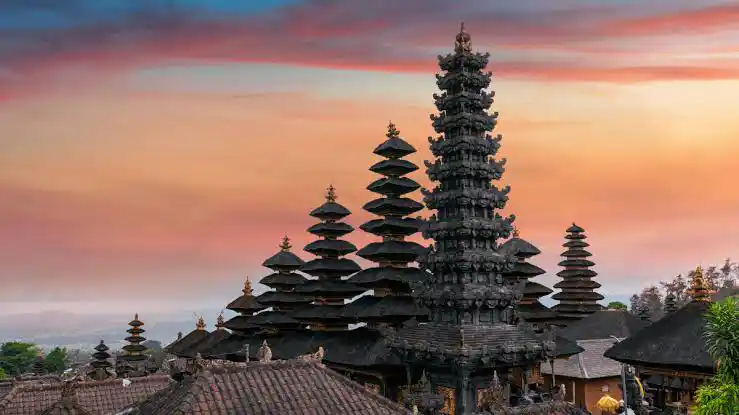
Ubud’s Hinduism is visible, elaborate, and deeply woven into the public life of the town. Temple ceremonies fill the streets with colour and sound. Offerings appear everywhere. Processions move through traffic with complete authority. The spiritual dimension of Balinese life is never far from view, and for many visitors, that visibility is part of what makes Ubud feel alive.
In Amed, the picture is different.
East Bali has a significant Muslim population alongside its Hindu community, and the result is a more mixed, less monolithic cultural landscape. The elaborate temple festivals and the grand public ceremonies that define Ubud’s spiritual identity are rarer here. Religion in Amed tends to be more intimate — practiced privately, within families, within homes. Ceremonies happen, but they often take place inside rather than in the street. There’s less display, less spectacle.
This isn’t a lesser version of Balinese culture. It’s a different expression of it. Less performed, more quiet. And for some people, that feels more honest.
What Amed also doesn’t have is the spiritual tourism industry that has grown up around Ubud — the healing retreats, the energy vortex tours, the guided ceremony experiences. In Amed, if you want to connect with the local culture, you do it by being present in daily life, not by booking something.
Climate
Humid jungle vs dry coast: the climate difference is real
Ubud sits inland, surrounded by jungle, at higher elevation. The humidity is constant and intense. Rain comes frequently — sometimes for hours at a time — and the air rarely feels dry. Mornings can be beautiful, but afternoons often bring heavy cloud. During the wet season, flooding is common and mould becomes part of daily life management.
Amed is coastal and much drier. The mountains behind the village catch most of the rain before it reaches the coast, and even in the wet season Amed tends to escape the worst of it. Rain here is seasonal and usually predictable — concentrated in the months from November to March — rather than the constant, unpredictable presence it is in Ubud.
Temperatures in Amed run hotter than Ubud. The sun is strong and direct, and midday heat on the beach can be serious. But there’s almost always a sea breeze — the kind that makes the heat manageable and makes late afternoons on the coast genuinely pleasant.
If you struggle with persistent humidity and grey skies, Ubud can feel oppressive during certain months. If intense heat and strong sun are the issue, Amed requires more care. But on balance, Amed’s climate tends to feel easier for long-term living — especially for people who find the inland humidity of Ubud hard to adapt to.
Daily Life
Traffic, services, and the texture of everyday life
Ubud has become considerably busier over the last decade. Traffic through the town centre and the surrounding main roads has grown substantially, and peak hours — and sometimes well outside peak hours — can mean serious congestion. The town centre itself is walkable, but getting anywhere beyond it requires navigating roads that are increasingly difficult.
Amed has no traffic problem. Not because it’s managed, but because the volume of vehicles simply isn’t there. The road along the coast is mostly clear, the village moves at its own pace, and getting from one end of the area to the other takes minutes rather than the unpredictable stretch of time it can take in Ubud.
In terms of services, Ubud has significantly more. More restaurants with serious variety, more international supermarket options, better medical access, more schools and activities for families, a larger and more diverse expat community. Amed has less of everything — and that’s not a neutral observation. If those things matter to your daily life, Ubud’s offer is genuinely stronger.
What Amed offers instead is the ocean. Ubud is landlocked, surrounded by rice terraces and jungle — beautiful, genuinely beautiful, but without the coast. If living close to the sea is a priority, that difference alone is often enough to settle the comparison.
The Honest Answer
Amed vs Ubud: who is each place for?
Ubud is the better choice if you’re drawn to Balinese Hindu culture in its most visible form, if you prefer a green inland landscape over a coastal one, if you need the services and community infrastructure a larger expat hub provides, or if you find the ocean less essential to your daily life than jungle and silence.
Amed is the better choice if the coast matters, if a drier climate appeals, if you want genuine quiet without crowds or traffic, and if you’re ready to trade services and variety for space, sea access, and a slower daily rhythm that isn’t organised around tourism.
Neither place is trying to be the other. That’s what makes the comparison clean.
More Comparisons
How does Amed compare to the rest of Bali?
Amed vs Canggu
The widest possible gap between two Bali destinations. What it looks like when a village becomes a digital nomad hub — and what Amed offers instead.
Amed vs Kedungu
Both away from the main tourist circuit — but very different in distance, price, and what the sea offers.
All comparisons →
Back to the full Amed vs other places in Bali overview.